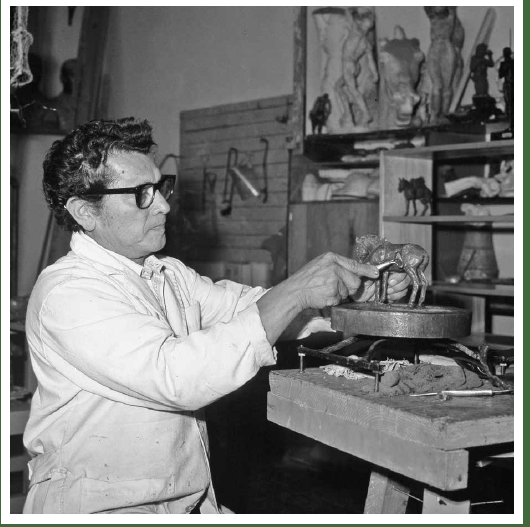
Andrés Peraza (1922–1998)
Andrés Peraza was a Mexican sculptor whose work spanned monumental sculpture, portraiture, wildlife studies, equestrian subjects, conceptual art, and the celebrated Cosmic Man series. Throughout a career that extended across several decades, his sculptures were exhibited in museums, universities, cultural institutions, public spaces, and private collections in Mexico and abroad.
Born on April 25, 1922, in Mérida, Yucatán, Peraza showed an early interest in drawing, observation, and artistic creation. At the age of eleven, he was sent to the Gulf Port Military Academy in Mississippi, where he spent three formative years. The discipline of military life, combined with exposure to new materials and techniques, had a lasting influence on his character and artistic development. During these years he began modeling his first sculptures using clay gathered during excursions into the countryside and experimented with plasticine, a material that would later become important in his creative process.
After returning to Mexico, Peraza continued his education and eventually moved with his family to Mexico City. During the 1940s he developed his earliest sculptural concepts and experimented with abstract forms that, at the time, were considered innovative and unconventional. His interests gradually expanded to include engineering design, machinery, wildlife, and the study of human movement and anatomy.
Throughout the 1950s and 1960s, Peraza refined his artistic vision while working in sculpture studios and developing themes that would recur throughout his career. These included representations of fauna, horses, historical subjects, and the concept that would eventually become his Cosmic Man series, one of the defining expressions of his artistic philosophy.
In 1964 he created Latimeria for the Natural History Museum in Mexico City, a work that marked an important stage in his professional development. During the following decades he completed numerous public commissions, monuments, portraits, and large-scale sculptures for governmental, cultural, educational, and private institutions.
The late 1970s and 1980s were particularly productive years. He participated in exhibitions in Mexico, Canada, and the United States, completed major commissions, and expanded the Cosmic Man series. His works entered prominent collections and institutions, including ITAM, the Tecnológico de Monterrey, museums, cultural centers, and public plazas throughout Mexico.
Peraza’s work reflects a lifelong fascination with movement, balance, nature, history, and the human spirit. Whether portraying wildlife, historical figures, equestrian themes, or conceptual subjects, his sculptures sought to capture both physical form and the deeper forces that animate life.
Andrés Peraza passed away in Mexico City on February 23, 1998. His artistic legacy continues through his family, published works documenting his career, public monuments, institutional collections, and the stewardship of the Andrés Peraza Estate.
Career Timeline
1922
Born in Mérida, Yucatán, Mexico.
1932–1934
Studies at Gulf Port Military Academy in Mississippi, USA, where he begins drawing and creating his first sculptures.
1938
Moves to Mexico City with his family.
1940–1944
Develops his earliest abstract sculptural concepts and designs.
1964
Creates Latimeria for the Museo de Historia Natural in Mexico City.
1978
First major one-man exhibition, participation in the X Sculpture Congress in Montreal, and creation of Aerial Duel.
1998
Passes away in Mexico City, leaving a substantial artistic legacy.